
Michigan City Previous Resident Sources
A backward address trail crosses several custodians. Beacon supplies a current parcel and owner lead. The LaPorte County Recorder preserves deeds and related instruments. Michigan City Public Library holds directories, historic deed indexes, newspapers, maps, and probate material. Census schedules provide household snapshots but are released under a 72-year rule. Choose the first source by era and by whether the question concerns ownership or occupancy.
| Source | Years represented | Where held | What it may show |
|---|---|---|---|
| Recorder deeds and indexes | Deed images described from 1832; indexed online ranges vary | LaPorte County Recorder and paid portals | Owners, transfers, legal descriptions |
| Michigan City directories | 1862-63 to 2004, with gaps | MCPL Reference Desk | Listed householders, addresses, work |
| LaPorte Directory | 2005-present | MCPL | Michigan City listings in county volume |
| Federal census | Through 1950 currently open | Library and federal databases | Household members at a census date |
| Historic land and probate files | Deeds 1833-1901; probate 1898-1920 | MCPL genealogy collections | Ownership and estate clues |
| Sanborn fire maps | 1884, 1889, 1899, 1905, 1912, 1929, 1936-48 | Indiana State Library and archives | Building footprint and use |
Dates above describe collections, not continuous coverage or proof that a person appears. Start from the newest dependable record and preserve the legal description, parcel number, directory edition, and page as separate identifiers.
Michigan City Resident Deed Chain
The LaPorte County Beacon search can accept a name, address, parcel ID, or alternate ID. Use it to normalize the current property and capture its legal description. Then move to the Recorder's index. A deed records an interest in land; it does not list all previous residents or prove who slept at the property.
- Find the current parcel by address and copy the parcel number, owner lead, and legal description.
- Locate that owner's purchase deed and record the instrument number, date, grantor, grantee, and prior reference.
- Search the seller as a grantee to locate the deed by which that party acquired the land.
- Repeat the grantor-to-grantee handoff, checking spelling variants and business names.
- When an electronic index stops, contact the Recorder for older books, microfilm, copies, and certification.
- Grantor and grantee
- The grantor transfers an interest; the grantee receives it.
- Chain of title
- The sequence of recorded transfers for the same land.
- Legal description
- The lot, block, subdivision, parcel, or metes-and-bounds text that identifies land despite a changed street number.
Do not publish a firm online cutoff without checking. Recorder materials describe back-indexing to 1900, a Laredo agreement lists grantor and grantee indexes from January 1966, and the same agreement describes deed images from January 1832.
The official Recorder fee sheet lists $1 copies through 11 by 17 inches, $5 for larger pages, and $5 certification. Those figures should be confirmed before ordering. Inspection can be more efficient than buying a long run of pages. Ask staff for the current instrument number, page count, image availability, and total delivery cost before deciding whether a plain or certified copy is needed.
Michigan City Resident Deed Portals
Fidlar Tapestry is a paid public route, while Laredo uses subscriber terms and access levels. Vendor search concepts include grantor, grantee, recording-date range, consideration, legal description, parcel or subdivision, document number, and document type. Current LaPorte fields, prices, and image limits were not verified, so the Recorder remains the fallback for a complete request.
Review the official Land Records entry page before a paid search. Its login and service model show why online access is only one channel. In-person inspection, phone questions, mail requests, and certified copies remain available through the LaPorte County Recorder at 555 Michigan Avenue, Suite 201, La Porte.
Michigan City Past Residents Trail
Ownership is only half the question. Printed directories may show a listed householder, spouse, occupation, phone, and address. Later criss-cross sections are organized by street or phone. The detailed year runs and reading conventions belong to the Michigan City city directories collection page.
Pair the closest directory before and after each open census year. As of August 2026, the 1950 federal census is open and the 1960 census is due in 2032. A census can show a full household on one date, while directories can narrow moves between ten-year counts.
- Copy the exact historic address and directory edition.
- Check the nearest open census, using ward or enumeration geography if needed.
- Compare names, ages, relationships, occupations, and nearby households without assuming every match is the same person.
- Move to the next directory year and date each change.
If a person vanishes, mark the result unresolved until an obituary, deed, new directory, or other dated source explains the change.
Residents who did not own the property can still appear in directories and census schedules. Conversely, a deed may name a trust, company, estate, or owner whose mailing address is elsewhere. Keep an occupancy column apart from an ownership column. This small distinction prevents the most common error in previous residents research: turning a property record into a claim about who lived inside the building.
Map Michigan City Resident Addresses
Old street numbers can break an otherwise sound search. Compare a city directory address with its Sanborn house or block number, a Recorder plat, and the present Beacon parcel. Michigan City was platted in 1835 around a town square bounded by Michigan Street, Franklin Street, Fourth Street, and Washington Street. That early grid gives downtown research a useful place anchor.
The Indiana State Library Sanborn inventory lists Michigan City editions from 1884 through 1948. Review its year list beside the captured page.
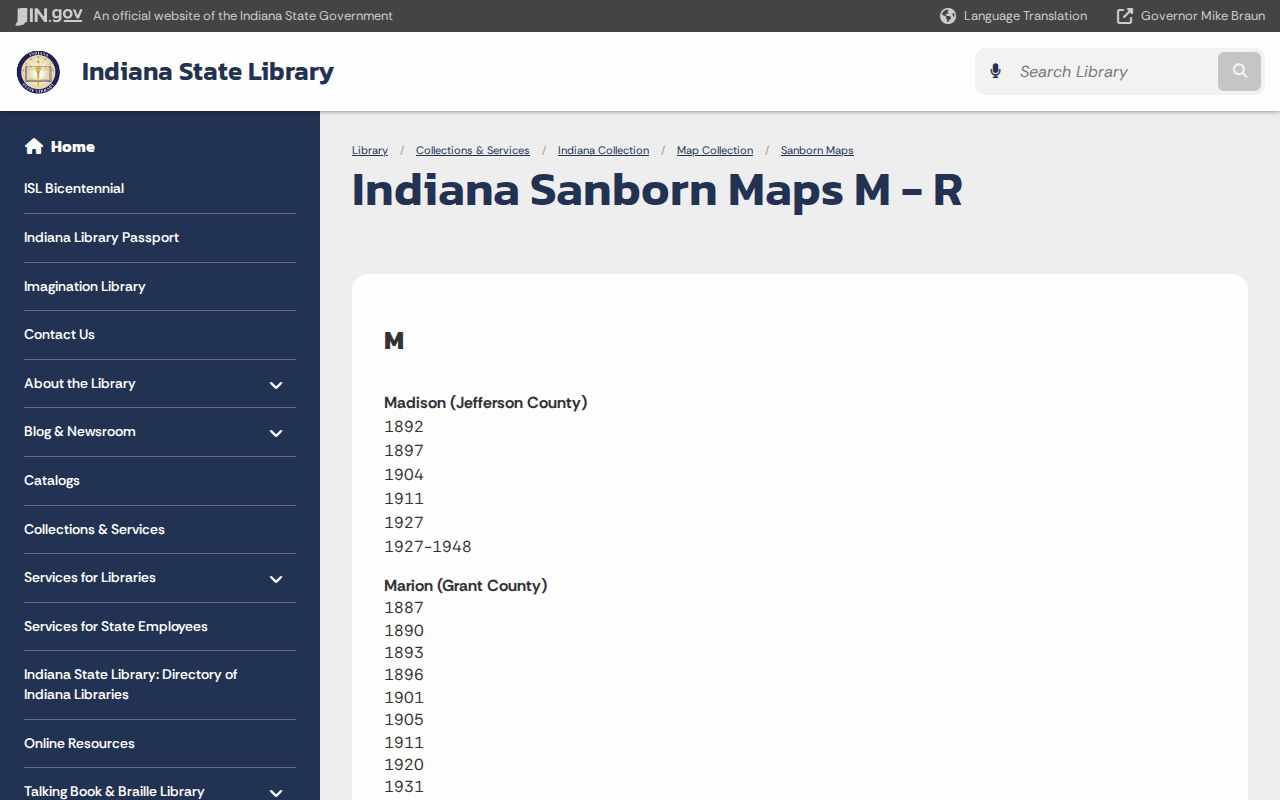
Those maps can show a building's footprint, materials, height, and use over time. They provide place history, not a roster of occupants. Cite both the map year and sheet when matching a prior address.
MCPL's land and property collection also lists an 1884 Michigan City map, county atlases from 1874, 1892, 1907, and 1921, an 1892 plat book, a county map from 1862, tract books, and taxpayer maps. A plat shows the legal division of land. An atlas can identify an owner or tract at a broad date. Neither replaces the recorded deed, but both can bridge a period when an address is absent from the electronic index.
Michigan City Resident Obituary Endpoints
The MCPL obituary index covers 1887 to the present. A result can supply name, date, newspaper, page, and column. Use that citation to inspect the page on a ViewScan reader. An obituary may identify a former address, spouse, cemetery, or organization, but it should not be copied wholesale or treated as proof of current residence.
MCPL lists three free ViewScan readers, $0.15 per printed page, and free saving or email. Mail or email research costs $5 for up to two obituaries. Ask 219-873-3044 to confirm the request route. Newspaper reels range from nineteenth-century titles through the current LaPorte County Herald-Dispatch.
Michigan City Cemetery Resident Records
Michigan City's Greenwood Cemetery was established in 1863 and dedicated in 1864. Its grounds include Greenwood proper, Sinai, Calvary, and Islamic sections. Preserve the named section in a burial result. MCPL adds Greenwood burial books for 1873-1950, Lots of Calvary from 1865, other LaPorte County cemetery volumes, and mortuary records.
The city cemetery office oversees Greenwood and Swan Lake and links a burial search. Send the full name and approximate death date when asking for help. An interment in Michigan City is a local connection, not proof that the person lived at the address being researched.
Note: Keep burial place, place of death, former address, and property ownership in separate fields until another record connects them.
Resolve Michigan City Resident Gaps
When the portal fails, work through the access chain. Ask the Recorder about the date, index book, image, copy fee, and certification. Visit the MCPL Reference Desk for directories, maps, newspapers, deeds, probate, and ViewScan. The Fern Eddy Schultz Research Library holds directories, family histories, clippings, legal documents, photos, telephone books, census indexes, cemetery files, house histories, and maps.
The Historical Society research library is open Tuesday through Saturday, 10:30 a.m. to 4:00 p.m. Staff assist visitors and correspondents but do not provide unlimited research. A publication titled “Researching House History” is listed, though its contents and current terms were not inspected. State Library and archive catalogs can extend the search, while the original custodian supplies certified copies.
For a municipal permit, zoning action, or existing building file, contact the Michigan City Planning and Zoning office or City Clerk. Cloudpermit is used for permits and property-change submissions, but its full public field set and historical coverage were not verified. A focused Indiana Access to Public Records Act request should name the address, department, record type, and date range. The agency need not create a new occupant list.
Use Michigan City Resident Records Carefully
A parcel owner, deed party, mailing-list name, obituary, burial, or permit applicant has a specific record role. None alone proves continuous occupancy. Keep a table with source, date, person, role, address as written, parcel or instrument number, and confidence level. Mark conflicts and gaps rather than forcing a complete story.
Previous residents research is appropriate for family history, estate work, building history, and personal curiosity. Minimize details about living people. Confirm any fact that matters with the office or archive holding the original record.
Lawful use. Never use a house-history search to track, threaten, stalk, or harass a living person.